
The short version of how to read a birth chart: start with three placements — your sun, moon, and rising sign — then read the whole wheel as a story about one person, not a list of traits. Sun is your core. Moon is your inner world. Rising is your first impression.
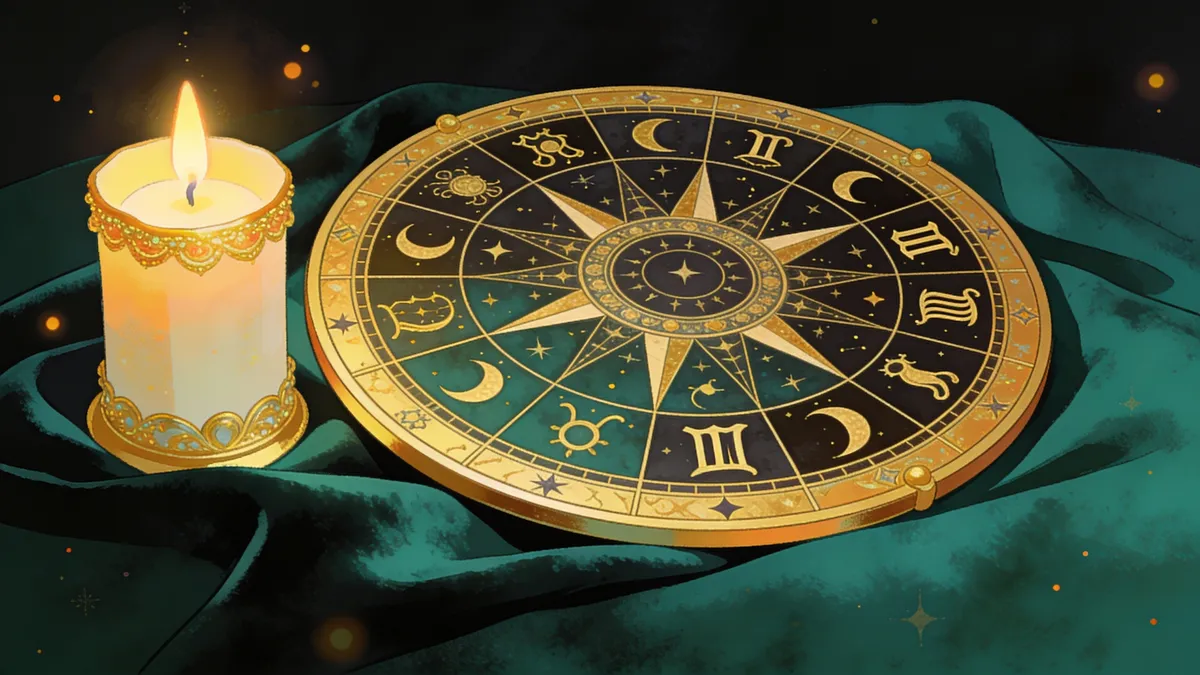
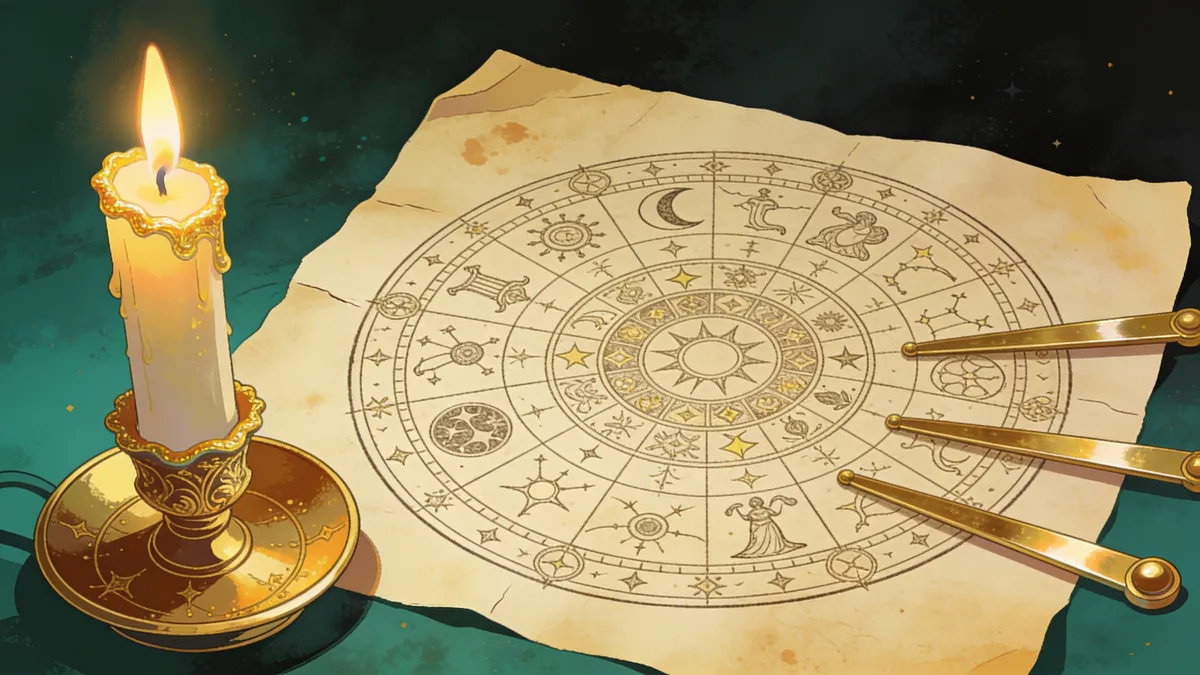
A birth chart is a snapshot of the sky at the moment you were born, drawn as a round wheel. Every planet sat somewhere specific, and astrologers read those positions as symbols for reflection — never a script for your life. This guide introduces the chart the way you’d introduce a person. Lead role first, then the supporting cast, the settings, and the plot.
How to Read a Birth Chart as a Story
Most guides hand you a checklist. Find your sun, find your moon, check your Saturn. That works, but it leaves you holding a dozen puzzle pieces and no picture on the box.
Here’s the shift that makes it click. A birth chart is a story about a person, and every symbol is either a character or a scene. Read it that way and the pieces start talking to each other.
Your big three are the protagonist. The planets are the supporting cast. The houses are the sets where scenes play out, and the aspects are the plot. A free calculator hands you the raw script — learning to read it is learning to tell the story back to yourself.
You’ll need three facts to draw an accurate chart: your birth date, your exact birth time, and your birthplace. All three change what was actually overhead — NASA puts it plainly in its explainer on constellations: which ones you can see depends on your location on Earth and the time of year. Astrologers read that sky symbolically, but the sky itself is genuinely specific to you.
The time matters more than people expect. Because the rising sign changes about every two hours, a fuzzy birth time can hand you the wrong one. Dig up your birth certificate if you can.
The Big Three: The Most Important Signs in Your Chart
If someone asks for the three most important signs in a birth chart, this is the answer: sun, moon, and rising. Together they’re called the big three, and they carry most of the story. Learn these and you already read a chart better than a horoscope app ever will.
This is also why a daily horoscope can feel so hit-or-miss. It’s written for your sun sign alone, which is one twelfth of the picture and the same paragraph millions of other people read that morning. Your chart is yours down to the minute and the city. That’s the gap between a generic forecast and a reading that’s actually about you.
Your sun sign is the protagonist — your core self, your ego, the thing you’re growing into. It’s the one most people already know. Say you were born in early August; your sun is likely in Leo, and Leo’s warmth, pride, and flair for performance become the spine of the story.
Your moon sign is the inner world. It’s how you feel, soothe yourself, and process everything when no one is watching. Two people can share a sun sign and feel like opposites, because one has a steady Taurus moon and the other a restless Gemini moon.
Your rising sign, or ascendant, is your first impression — the vibe you give off before you say a word. It’s the sign that was climbing over the horizon at your birth, which is why the exact minute counts. Think of it as the costume your protagonist wears on stage.
When you sit down with a fresh chart, read them in that order. Sun for the core, moon for the private truth, rising for the surface. Nine times out of ten, the interesting part is the gap between them — the confident Leo who quietly needs reassurance, or the calm face over a stormy inner tide.
Put the three together and a picture forms. A Leo sun with a Cancer moon and a Virgo rising reads as a warm performer who feels things deeply in private and comes across as tidy and helpful. Same person, three layers, one story.
Start Your Reading
The Planets: Your Chart’s Supporting Cast
Beyond the big three, eight more planets round out the cast, and each one governs a different part of life. You don’t read them one at a time and stop there. You read what each one is doing and how it colors the lead.
Mercury runs your mind and your messages — how you think, text, and argue. Venus handles love, taste, and what you find beautiful. Mars is your drive and your temper, the engine under the hood. Learn those three and you’ve covered how a person thinks, loves, and fights.
The slower planets paint in broader strokes. Jupiter shows where you grow and get lucky. Saturn marks where you work hardest and mature the most. Uranus, Neptune, and Pluto crawl so slowly that they color whole generations more than a single life.
A quick note on the word planet. In chart-speak the sun and moon count as planets too, alongside the eight others — ten moving parts in all. You may also spot the word retrograde beside one. Read it gently: a retrograde planet asks you to slow down and revisit that area, not a warning that something will go wrong.
Each planet also lives in a sign, which is its flavor, and a house, which is its setting. Venus in Scorpio loves intensely and privately. Venus in the fifth house looks for love through play and romance. Reading a chart means holding both at once.
The Houses: Where the Story Happens
If planets are the cast and signs are their flavor, the twelve houses are the sets. Each house rules a slice of life — money, home, career, other people. A planet’s house tells you where its energy tends to show up day to day.
The houses fan out from the eastern horizon and run counterclockwise. The line that starts the first house is your rising sign, which is why so many astrologers call the first house the most powerful in the chart. It frames everything that follows, like the opening scene that sets up a film.
| House | Life area | One-line read |
|---|---|---|
| First | Self & identity | How you show up and start things |
| Second | Money & values | What you own and what you prize |
| Third | Communication | How you think, talk, and learn |
| Fourth | Home & family | Your roots and private base |
| Fifth | Creativity & romance | Play, dating, self-expression |
| Sixth | Work & health | Daily habits and routines |
| Seventh | Partnership | Close one-on-one relationships |
| Eighth | Depth & sharing | Intimacy, change, shared resources |
| Ninth | Belief & travel | Big ideas, study, far horizons |
| Tenth | Career & reputation | Your public role and ambitions |
| Eleventh | Community & hopes | Friends, networks, and goals |
| Twelfth | Rest & the unseen | Solitude, dreams, and closure |
You don’t memorize all twelve on day one. Notice which houses hold planets and which sit empty. A cluster of three or more planets in one house — a stellium — points to a life theme that keeps demanding your attention.
And don’t worry about the empty houses. Most charts have several, and an empty house isn’t a hole in your life — it just means that area runs on quieter, background energy. You still have a home, friends, and a career whether or not a planet is parked there. The busy houses are simply the ones the story keeps returning to.
The Aspects: The Plot Between the Planets
Aspects are the angles planets make to each other, and they’re the plot of your chart. They describe who gets along and who creates tension. This is where a flat list of placements turns into a living story.
You don’t need all of them to begin. Focus on two. A conjunction is two planets sitting together, blending into one loud voice. A square is a ninety-degree standoff — friction that pushes you to grow, like two characters who clash in every scene.
Trines are the easy chemistry, the gifts that come so naturally you can take them for granted. Oppositions sit across the wheel and ask for balance between two pulls. None of these are good or bad. They’re just the relationships that give a chart its drama and its warmth.
One practical tip: read the tightest aspects first. The closer two planets sit to an exact angle, the louder that relationship speaks in the chart. A square that’s nearly exact will shape someone far more than one that’s barely in range.
A Worked Example: Reading One Placement
Let’s read a single placement the story way. Say a chart has Mars in Libra in the seventh house. Three clues, one sentence.
Mars is drive and conflict. Libra is the sign of balance and partnership. The seventh house is the house of close relationships. Put them together, and here’s a person whose fight tends to surface inside their relationships — someone learning to argue fairly instead of keeping the peace at any cost.
That reading isn’t a verdict. It’s a mirror — a prompt to notice a pattern and decide what to do with it. That’s the whole craft: gather the clues, tell the honest story, and hand the choice back to the person living it.
Try the same trick on your own loudest placement. Name the planet, name its sign, name its house, then say it as one plain sentence about a person. If that sentence makes you nod — or wince a little — you’re reading the chart, not just decoding it.
The same instinct powers other reflective tools. If repeating numbers catch your eye, our angel numbers guide reads them the same way — as prompts, not predictions. A sequence like 111 gets treated as a nudge to notice your thoughts, not a fixed fortune.
How to Go Deeper
Once the big three feel familiar, add one layer at a time. Pull up a free chart, find your sun, moon, and rising, and write one sentence for each. Next week, add Mercury, Venus, and Mars. Slow beats thorough when you’re starting out.
Here’s a simple rhythm to build the habit. Week one, learn your big three cold. Week two, place your Mercury, Venus, and Mars. Week three, notice your busiest house and your tightest aspect, and by month’s end a stranger’s chart will give you something true to say.
It helps to remember the sky is real before it’s symbolic. The band of twelve constellations the sun appears to travel through is the zodiac, mapped by stargazers long before any app existed. Astrology borrows that map and reads meaning into it — a language for reflection, not a forecast.
Keep the framing honest. A birth chart is for insight and entertainment, a way to think about yourself out loud — not medical, legal, or money advice, and never a promise about what’s coming. If you like this kind of reflection, the Moon tarot card works the same muscle: symbols in, honest questions out.