The Moon tarot card meaning, in one breath: things are not clear right now, and your imagination is filling the gaps. It’s the card of fog, intuition, and the stories we tell ourselves in the dark — some true, some just loud. Upright, it asks what you’re not seeing. Reversed, it usually means the fog is starting to lift.
Whenever this card lands on the kitchen table in a reading for a friend, the reaction is always the same little wince. Let me talk you out of the wince. The Moon isn’t bad news. It’s a flashlight pointed at the one place you’ve been avoiding.
Here’s the whole card on one page before we take it apart.
| You are asking about | Upright | Reversed |
|---|---|---|
| The overall message | Low visibility — the picture in your head has drifted from the facts | Fog lifting — the situation starts making sense again |
| Love | The unspoken thing, and the mind-reading standing in for a conversation | The talk finally happens, or the story you built quietly deflates |
| Work | Rumor season: reorgs, re-read emails, timelines built out of dread | A confirmed fact replaces the guesswork |
| Your own head | Imagination running ahead of the evidence | Either clarity, or a stubborn attachment to the comfortable story |
| What to do next | Slow down, name the unknown, verify before you act | Ask the question while the light is good |
What’s Actually on the Card
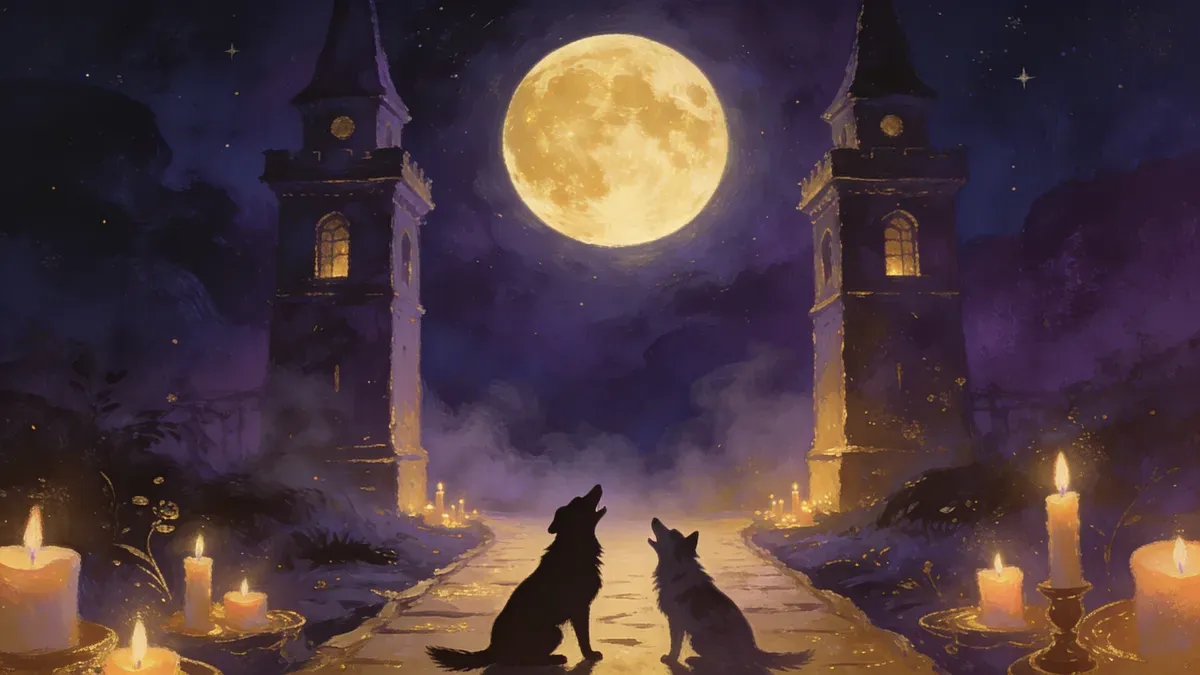
Look at the classic Rider-Waite image and the whole meaning is right there. A full moon hangs over a night path. A dog and a wolf howl up at it — the tame mind and the wild one, both rattled by the same light. A crayfish crawls out of the water, ancient and half-formed, like a fear surfacing from somewhere deep.
Two towers frame a path that runs to the horizon. You can’t see where it ends. That’s the card: you have to walk without full information, and everything half-seen looks bigger than it is.
Tarot itself started as a fifteenth-century Italian card game before mystics adopted it for reflection — the history of tarot is shorter and stranger than most people assume. The Moon has been unsettling players and seekers for roughly five centuries. You’re in good company.
The Moon Tarot Card Meaning, Upright
Upright, The Moon says: the picture in your head and the facts on the ground have drifted apart. Maybe a coworker’s short email spun into a whole firing scenario by lunch. Maybe a partner’s quiet week became proof of something it never was. The Moon doesn’t say your instincts are wrong — it says they’re unverified.
There’s a softer side too. This card loves intuition, dreams, and the knowing that arrives before the evidence does. If you’ve been getting a gut feeling you can’t explain, The Moon says write it down. Just don’t act on it at midnight.
Read it the way I do at my table: The Moon is a season of low visibility, not a verdict of doom. Nobody drives fast in fog. Slow down, use your low beams, and wait for morning before you decide what the shapes on the road actually were.
Related: Angel Numbers: A Complete Beginner's Guide
Start Your Reading
The Moon Reversed
Reversed, most readers take The Moon as fog lifting. The confusing situation starts to make sense. The anxiety that ran your week shrinks the moment you finally look at it straight on. Secrets surface — often smaller and less dramatic than the versions your imagination built.
Some readers flip it the other way and see self-deception digging in, a person choosing the comfortable story over the true one. Both readings share a spine: the truth is on the move. Your job is to stop feeding the fiction.
A quick example. One regular at my kitchen table drew The Moon reversed while agonizing over a job offer she was sure was “too good.” We talked it through, and the catch she kept sensing turned out to be her own fear of leaving a team she loved — real, but nothing like the trap she’d imagined. The card didn’t decide for her. It just showed her which fear was actually hers.
The Moon at Work and in Everyday Questions
Career spreads get their own flavor of fog. The Moon in a work reading often lands when the office is thick with rumor — a reorg nobody will confirm, a manager whose feedback you keep re-reading like tea leaves, a role that was promised and then went quiet.
The card won’t tell you whether the promotion is coming, and neither will I. What it offers is a better question: where am I trading facts for guesses? Ask for the meeting instead of decoding the calendar invite. Ask what the timeline is instead of building one out of dread.
One more everyday note. The Moon has an old association with cycles — astrologers link the card to Pisces and to the tides — so some readers take it as “give this a full cycle before you judge it.” Whatever you think of that, the advice holds up: foggy situations rarely resolve on the day you want them to.
The Moon in Love Readings
In love, The Moon almost always points at the unspoken thing. The question you haven’t asked. The assumption doing the work a conversation should be doing.
If you’re partnered, it’s an invitation to trade mind-reading for asking. Maybe you’ve decided their long hours mean distance when they mean a deadline. Maybe they’ve decided your silence means anger when it means tired. The Moon doesn’t know which — it just knows you’re both guessing.
If you’re single, this card can point at a half-imagined situationship, where the story you’ve built outweighs the evidence you actually have. Three great dates and two weeks of quiet is three great dates and two weeks of quiet. Read the facts before you read the cards.
Does it mean someone’s lying? Sometimes people want it to. But at my table, nine times out of ten, The Moon is about the fiction we write ourselves — and no card is ever proof of anything about another person. Treat it as a prompt for one honest question, asked kindly.
And remember what a reading is. It’s a mirror and a conversation starter, for entertainment and reflection. Big relationship decisions deserve daylight, time, and real talks — not a single card pulled between errands.
The Moon never tells you what’s out there in the dark. It asks why you’ve decided it’s a wolf.
What to Do When You Pull The Moon
First, don’t panic — that’s the card winning. Then try this three-step routine I give everyone at my table.
Name the fog. Write one sentence: “I don’t actually know ___ yet.” Just naming the unknown shrinks it. Most Moon-season anxiety is a missing fact wearing a monster costume.
Check the story. Take the scariest version you’ve been rehearsing and ask what evidence supports it. Not vibes — evidence. If the answer is “a feeling and one weird text,” you’ve found the fiction.
Wait for daylight, then ask. Fog burns off with information. Ask the question, request the meeting, get the second opinion. The Moon’s whole lesson is that clarity is usually one honest conversation away.
The card pairs beautifully with dreamwork, by the way — moon energy and dreams about falling tend to show up in the same anxious seasons, and they respond to the same cure: look directly at the thing.
Related: Dreams About Falling: What They Really Mean
If The Moon keeps finding you, browse the rest of our tarot card meanings or start with the angel numbers guide — different tools, same job. They hand you a question. You bring the honesty.