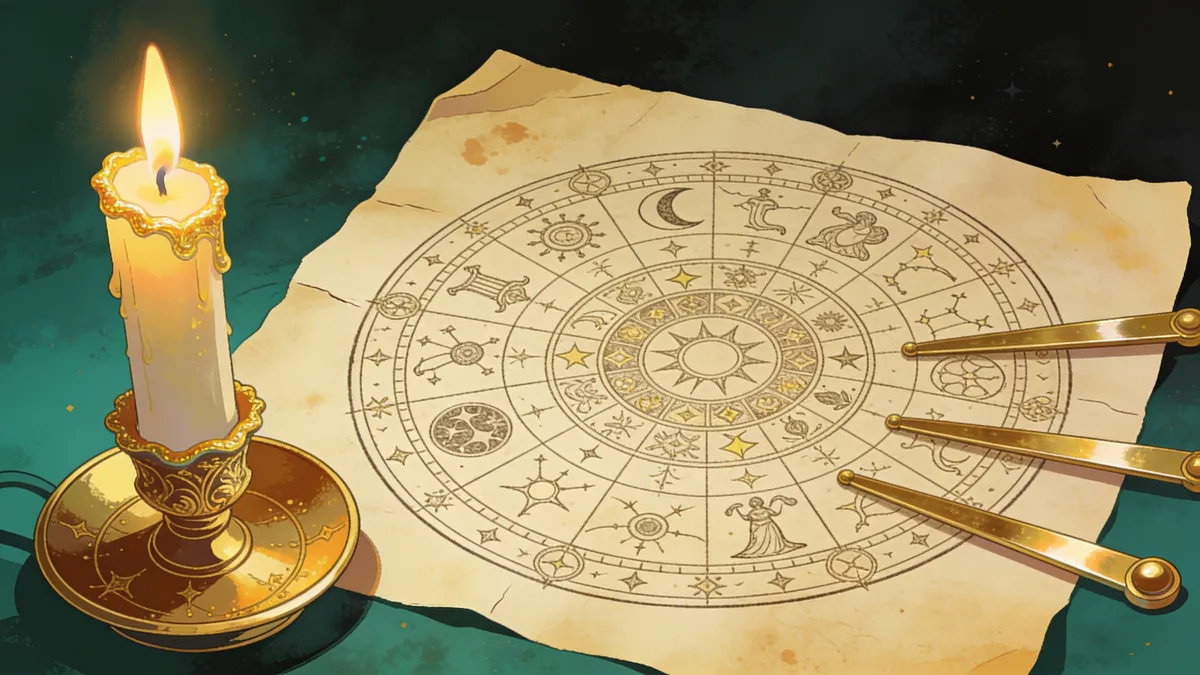
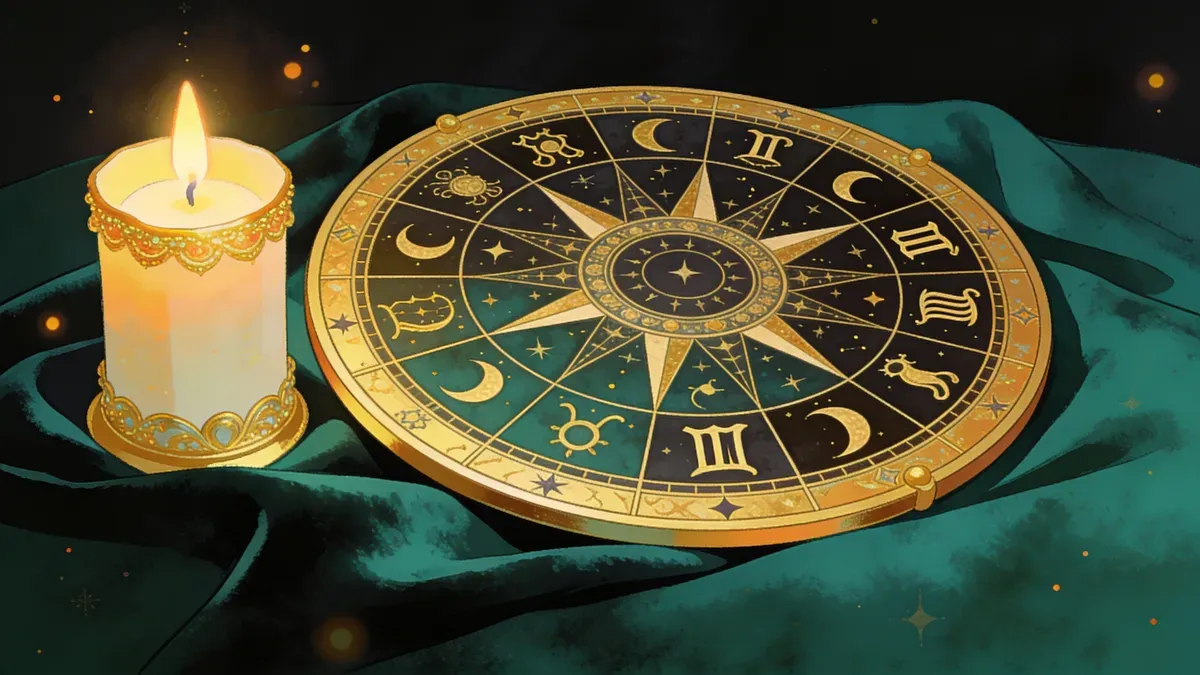

An astrology houses birth chart reading splits the wheel into twelve life areas — self, money, home, career, love — and reads whichever planets land in each one. Signs tell you how you do something. Houses tell you where it plays out.
That distinction is the whole game, and it’s the part most beginner guides rush past. So let’s slow down on it before we walk the twelve.
The Three Questions: Planet, Sign, House
Every placement in your chart is three pieces of information stacked together, and each piece answers a different question.
Planet — what? The planet names the drive. Venus is affection and taste, Mars is anger and effort, the sun is identity. NASA counts eight planets in the solar system, and chart-speak adds the sun and moon to that list, so astrologers work with ten moving parts.
Sign — how? The sign is the flavor, the manner, the accent. Mars in Libra fights politely. Mars in Aries fights immediately.
House — where? The house is the room it happens in. Mars in the sixth house takes that drive to work. Mars in the seventh takes it into a relationship.
Say all three out loud as one sentence and you’ve read the placement. “Mars in Libra in the seventh house” becomes this person’s fight shows up inside their close relationships, and they’d rather keep the peace than win. No jargon, no lookup table, just three questions in order.
What Astrology Houses Birth Chart Readings Actually Tell You
Here’s the twelve, each with the question it answers rather than a paragraph you have to memorize.
| House | Type | Natural sign | The question it asks |
|---|---|---|---|
| 1st | Angular | Aries | Who am I when I walk in? |
| 2nd | Succedent | Taurus | What do I own and value? |
| 3rd | Cadent | Gemini | How do I think and talk? |
| 4th | Angular | Cancer | Where do I come from? |
| 5th | Succedent | Leo | What do I do for joy? |
| 6th | Cadent | Virgo | How do I spend an ordinary Tuesday? |
| 7th | Angular | Libra | Who do I meet as an equal? |
| 8th | Succedent | Scorpio | What do I share, and what changes me? |
| 9th | Cadent | Sagittarius | What do I believe, and how far will I go? |
| 10th | Angular | Capricorn | What am I known for? |
| 11th | Succedent | Aquarius | Who's in my corner? |
| 12th | Cadent | Pisces | What runs underneath all of it? |
That middle column is the thing most beginner guides leave out, and it’s the fastest way to rank a chart by loudness.
Start Your Reading
Angular, Succedent, Cadent: Which Houses Shout
The twelve houses come in three groups of four, and the group tells you how insistent a placement tends to be.
Angular houses — 1st, 4th, 7th, 10th — sit on the four corners of the wheel. They’re the beginnings: identity, home, partnership, public role. A planet parked in one of these tends to be visible in your life whether you like it or not.
Succedent houses — 2nd, 5th, 8th, 11th — come next, and they’re about holding and building. Resources, pleasure, intimacy, community. Steadier, slower, less dramatic.
Cadent houses — 3rd, 6th, 9th, 12th — are the processing rooms. Thinking, routines, belief, rest. Planets here work in the background, and people often underrate them.
So if you’re staring at a chart and don’t know where to start, start with anything in an angular house. That’s the part of the story that keeps interrupting.
Where Do the Houses Even Come From?
Not from the constellations. The houses come from the ground under your feet.
The wheel is anchored to your local horizon at the moment you were born, which is why two babies born the same minute in different cities get different house layouts. The sun’s position in the sky is genuinely local — NOAA’s calculator works out sunrise, sunset, and solar position for any place on Earth because there’s no single answer that fits everyone.
The line that starts the first house is your rising sign, the point that was climbing over the eastern horizon. Everything else fans out counterclockwise from there. That’s also why your birth time matters so much: the whole house structure rotates as the Earth does, at roughly one sign every two hours.
If your birth time is a guess, your signs stay put but your houses can slide. Worth knowing before you build a whole self-image on a fourth-house Saturn.
Signs come from the sky. Houses come from the ground. That’s why your birthplace changes the chart as much as your birthday does.
How to Read Your Own Houses in Ten Minutes
Pull up your chart and do this in order. It takes less time than you’d think.
Find the busiest house first — the one with the most planets stacked in it. Three or more is called a stellium, and it points to a theme your life keeps circling back to. That’s your headline.
Then find your first house and note its sign. That’s your rising, and it sets the tone for everything else. Our guide to sun, moon, and rising covers why that one placement does so much work.
Then take the loudest single planet and say the three-question sentence out loud. Planet, sign, house. If the sentence sounds like a real person you know, you’re reading it properly.
Why Two Birth Chart Sites Give You Different Houses
Here’s the thing that trips people up on day two, and almost no beginner guide warns them about it. Run your details through two different chart calculators and your houses may not match.
The signs will agree. The planets will agree. But the house boundaries can shift, because there’s more than one method for slicing the circle. The two you’ll meet most often are Placidus and whole sign.
Whole sign is the simple one. Whatever sign your rising falls in becomes the entire first house, the next sign is the whole second house, and so on. Twelve equal slices, one sign each.
Placidus divides by time rather than by sign, so houses come out uneven — some wide, some narrow, and a sign can be swallowed inside a single house. Most modern software defaults to it, which is why your chart probably looks lopsided.
Neither one is the correct answer, and astrologers have argued this for centuries without settling it. If a placement lands near a house line, read both versions and keep whichever describes your life better. That’s not cheating. That’s how the craft has always worked.
The Empty House Myth
Ten bodies, twelve houses. The arithmetic guarantees empty houses in almost every chart, and yet this is the question I hear most from people opening their first chart.
An empty seventh house does not mean you’ll be alone. An empty second house does not mean money trouble. It means that area of life runs on the sign on its cusp and its ruling planet, quietly, without a planet parked there demanding attention.
Honestly, empty houses can be a mercy. The busy ones are where the friction lives.
If an empty house still nags at you, there’s a way to read it. Look at the sign sitting on its cusp, then find that sign’s ruling planet elsewhere in the chart and see which house that one landed in. An empty seventh house ruled by a Venus in the tenth suggests relationships that tend to form through work. It’s a quieter signal than a planet parked in the house itself, and it’s usually enough.
What the Houses Look Like in Real Life
Theory is easy to nod along with and hard to use, so here are three placements read the whole way through.
Moon in the fourth house. Moon means feelings, fourth means home. This is someone whose mood tracks the state of their living space, who needs a door they can close, and who probably still processes family stuff more than they admit.
Saturn in the eleventh house. Saturn means effort and slow mastery, eleventh means friendship and community. Read it as someone who takes years to build a circle and then keeps it for life. Not lonely — selective, and often the person everyone else relies on.
Jupiter in the third house. Jupiter is expansion, the third is talk and learning. Big talker, wide curiosity, a person who explains things to strangers at parties and means well by it.
Notice that none of those are predictions. Each is a pattern with a question attached, and the reader is the one who decides what to do about it.
Reading It Honestly
Houses are a language for reflection, not a forecast. They can show you where a pattern tends to surface and give you a better question to sit with — they can’t tell you what happens next, and they have nothing worth saying about your health, your money, or a legal matter.
If you want the rest of the wheel, our beginner’s guide to reading a birth chart covers planets and aspects, and how to read the chart wheel explains the diagram itself.
When you’d rather skip the study and just ask about your own chart — the situation, the timing, the person on your mind — that’s what a reading is for. Get one built from your houses, not your sun sign, and stop guessing.