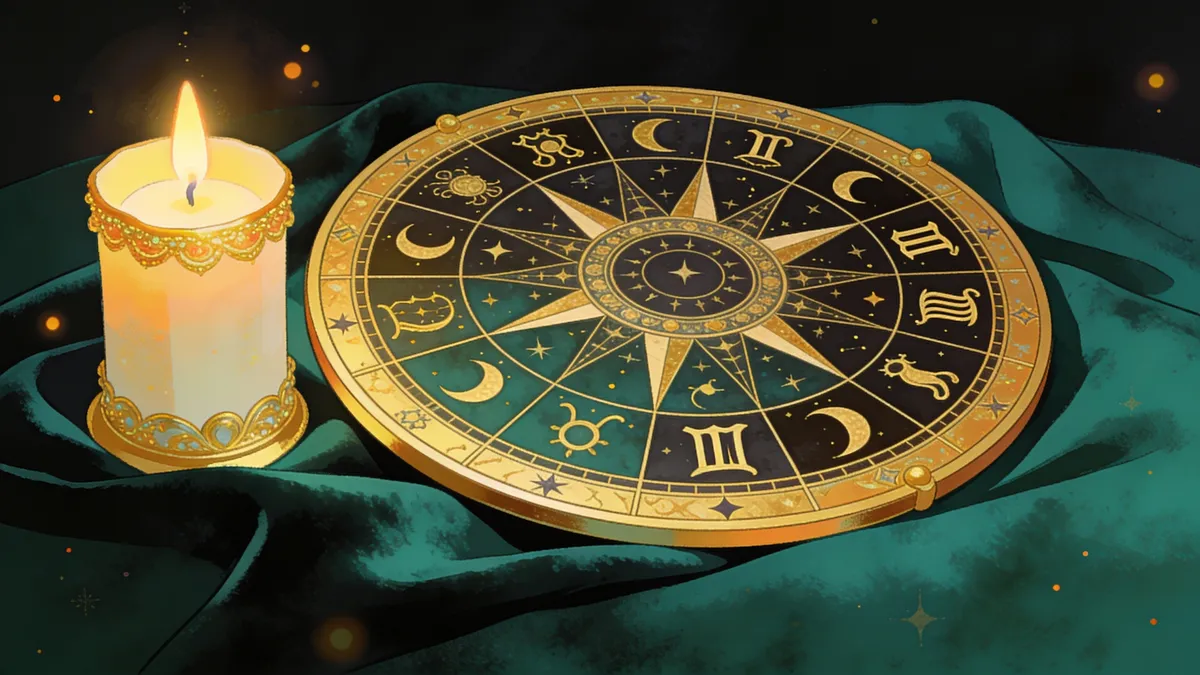
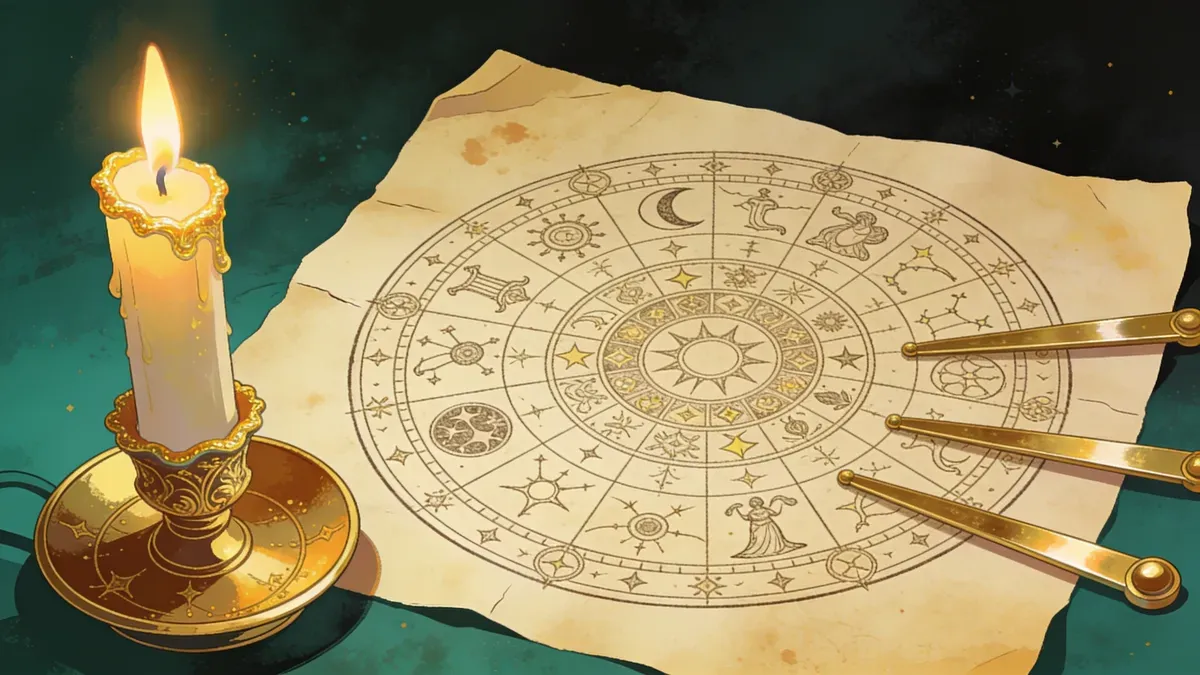

Here’s how to read birth chart wheel diagrams: find the line at the nine o’clock position, because that’s your rising sign and the start of house one. Read counterclockwise from there. Outer ring is signs, inner spokes are houses, and the scattered symbols are planets.
Most people don’t get stuck on what a chart means. They get stuck on the picture — a circle covered in glyphs, spokes, and crossing lines, with no obvious place to start. So this is a guide to the diagram itself.
The Clockface Method: Getting Your Bearings
Every chart wheel is a circle, and every circle looks the same until you know which way is up. So borrow a clock face. Four positions, four landmarks, and the whole diagram stops swimming.
Nine o’clock — the ascendant. The left edge. Your rising sign, and the starting line of the first house. This is where you always begin.
Six o’clock — the imum coeli. The bottom. Start of the fourth house: home, roots, the private base.
Three o’clock — the descendant. The right edge, directly opposite your rising. Start of the seventh house: partnership and close one-to-one relationships.
Twelve o’clock — the midheaven. The top. Start of the tenth house: career, reputation, what you’re known for. These four lines are usually drawn thicker than the rest, and that’s the software telling you they matter most.
Notice the logic. The left edge is the eastern horizon at your birth, the bottom is the sky beneath your feet, and the top is directly overhead. The wheel is a picture of a real sky over a real place.
How to Read Birth Chart Wheel Rings, Outside In
The diagram is layered, and the layers have an order. Work from the rim toward the middle.
Outer ring — the signs. Twelve wedges of thirty degrees each, marked with zodiac glyphs. These come from the band of constellations the sun appears to travel through, and the sky itself is genuinely specific: NASA notes that which constellations you can see depends on your location and the time of year.
Middle ring — the houses. Spokes cutting the circle into twelve numbered slices, running counterclockwise from the ascendant. Note that the sign wedges and the house slices rarely line up, and that’s normal.
Inner area — the planets. Symbols placed at their exact positions, each with a small number beside it. That number is degrees within the sign, 0 through 29.
Center — the aspects. Lines drawn between planets that sit at meaningful angles to each other. Solid, dotted, and colored lines usually mean different aspect types; every chart tool has a legend.
Start Your Reading
Decoding the Glyphs Without Memorizing Them
Glyphs look like a secret alphabet, and mostly they’re pictures. A few shapes carry a lot of the load.
| What you see | What it is | What it tells you |
|---|---|---|
| Circle with a center dot | The sun | Core self — read it first |
| Crescent | The moon | Inner emotional world |
| Heavier line at the left edge | Ascendant | Rising sign, start of house 1 |
| Heavier line at the top | Midheaven | Career and public role |
| Small number beside a glyph | Degree in sign | Exact position, 0–29 |
| ℞ beside a planet | Retrograde | Slow down and revisit that area |
| Lines across the center | Aspects | How planets talk to each other |
| A house with no glyphs | Empty house | Quiet area — nothing is missing |
The retrograde mark is worth a gentler read than it usually gets online. It’s an invitation to revisit and rework something, not a warning that a thing will go wrong.
Why Your Wheel Looks Different From Your Friend’s
Two people born the same day get different wheels, and the reason is the horizon rather than the stars.
Sunrise happens at a different clock time in Denver than in Boston on the same date, which is why the US Naval Observatory publishes rise and set times computed for one place on one day instead of a single table for the whole country. Your ascendant follows that same local horizon.
Since the whole wheel rotates about one sign every two hours, a fuzzy birth time doesn’t just move your rising sign. It rotates every house boundary with it, and planets slide from one slice to the next.
The signs come from the sky, but the wheel comes from the ground you were standing on. That’s why the exact minute and the exact city both matter.
Five Mistakes Almost Everyone Makes First
I see the same handful of misreadings over and over, and every one of them is a diagram problem rather than an astrology problem.
Reading clockwise. The houses run counterclockwise from the left edge. Read the other way and you’ll have your seventh house sitting where your first belongs, which scrambles everything after it.
Assuming signs and houses line up. In most house systems they don’t. Your first house can start halfway through a sign, and one sign can stretch across two houses. That’s normal, not an error in the software.
Mistaking the degree number for the house number. The small figure beside a planet is its position within a sign, 0 to 29. The plain numbers around the inner rim are the house numbers. Two different systems, two different meanings.
Treating aspect lines as good or bad. A dense web of lines across the middle isn’t a warning. It means the parts of the chart are in heavy conversation with each other, which tends to make for an interesting person rather than a doomed one.
Panicking about empty houses. With ten bodies and twelve houses, gaps are guaranteed. An empty slice means that area runs quietly, not that it’s missing from your life.
The Five-Pass Reading Order
Don’t try to take in the whole circle at once. Five short passes, in this order, and each one builds on the last.
Pass one: the angles. Name your ascendant and midheaven signs. Two facts, thirty seconds.
Pass two: the big three. Find your sun, moon, and rising, and note what sign each sits in. Our guide to sun, moon, and rising covers what to do with them.
Pass three: the crowd. Scan for the house holding the most planets. That’s your loudest life theme, and the twelve astrology houses explain what each slice governs.
Pass four: the personal planets. Locate Mercury, Venus, and Mars — how you think, love, and fight. Say each one as a sentence: planet, sign, house.
Pass five: the tightest line. Look at the aspect lines and find the two planets closest to an exact angle. That relationship speaks loudest in the chart.
Do those five and you’ve read the wheel. Everything after that is depth, not entry.
A note on the aspect lines, since pass five is where most beginners stall. You don’t need to identify every angle by name. Just find the two planets whose line looks tightest and ask a plain question: do these two want the same thing, or are they pulling against each other? A conjunction blends two voices into one loud one, and a square sets them at odds in a way that tends to produce growth rather than disaster.
Reading a Wheel That Isn’t Yours
Once your own chart stops looking like static, try a friend’s. It’s the fastest way to find out whether you’re actually reading or just recognizing your own life in the symbols.
Run the same five passes, but say every observation out loud as a sentence about a person. “Their Mars is in the tenth house, so their fight shows up at work.” Then check it. Sometimes you’ll be wrong, and being wrong out loud is how the skill sharpens.
Keep one habit while you do it. Say the thing you notice, then hand the meaning back — ask what they make of it rather than telling them what it means. That’s the difference between reading a chart with someone and reading a verdict at them.
What the Wheel Can and Can’t Do
A chart wheel is a mirror with a lot of detail in it. It can show you patterns worth thinking about and hand you a sharper question — it can’t predict what’s coming, and it has nothing useful to say about your health, your money, or a legal problem. Those belong with real professionals.
Read symbols the way you’d read a dream. Our guide to dreams about falling works the same muscle: image in, honest question out, decision still yours.
When you’d rather ask about your own wheel than study one — the placement you keep staring at, the timing, the person on your mind — get a reading built from your actual chart and stop guessing.